HubSpot data in Power BI, with the depth the BI team needs.
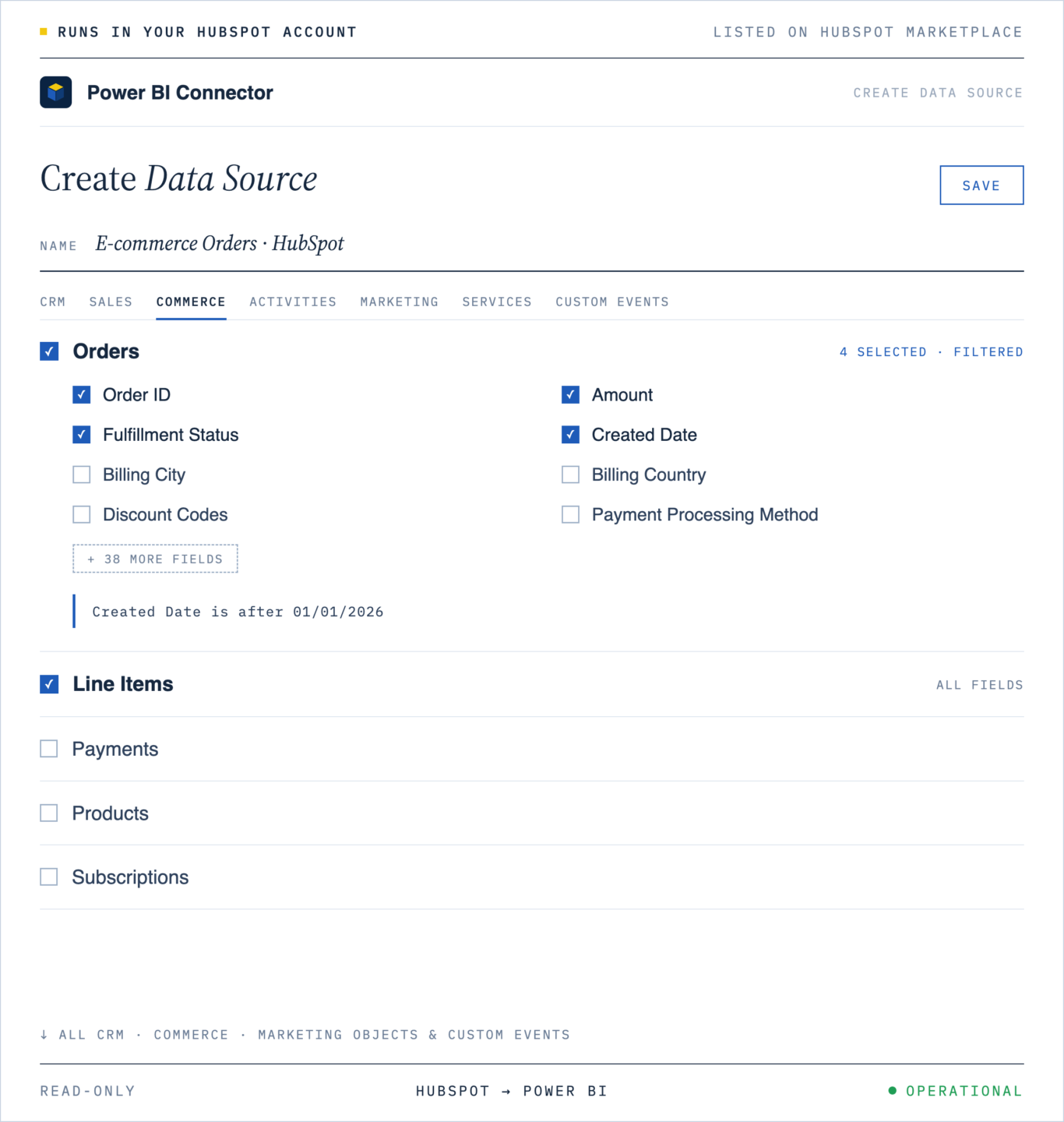
A no-code, production-grade connector that exposes the full HubSpot object graph to Power BI — Contacts, Companies, Deals, Tickets, Marketing events and custom objects — without CSV exports, brittle middleware, or API-throttling workarounds.
In production
at enterprises like



/ 01 · ARCHITECTURE
A safer alternative to exports and middleware.
Replaces CSV exports, third-party iPaaS recipes, and one-off scripts with a supported Power BI HubSpot connector — engineered for stable production operation rather than a short-lived setup that breaks at the next API change.
/ 02 · RELIABILITY
Built for revenue-critical reporting.
Designed for organizations where HubSpot powers the funnel and Power BI powers the company dashboard — pipeline coverage, MQL-to-revenue attribution, campaign ROI, and retention analytics that the business reads every week.
/ 03 · STABILITY
Predictable behavior as HubSpot evolves.
New custom properties, pipelines, and object types appear in HubSpot constantly. The connector picks them up without schema drift breaking Power BI models, so reporting keeps pace with go-to-market changes instead of trailing them.
/ 04 · ECONOMICS
Lower cost of ownership.
Avoids the accumulated cost of third-party ETL seats, custom Zap chains, and maintenance tickets. A supported connector replaces pipeline bricolage and the people-hours required to keep each moving piece alive.
/ 05 · GOVERNANCE
Governed at the point of access.
Respects HubSpot scopes, access tokens, and property-level permissions. Analytical access stays auditable and consistent with the source — no sprawl of replicated CRM exports living on analyst laptops.
/ 06 · OPERATING MODEL
No-code, owned by the team that reports.
Marketing ops, RevOps, and BI can own the connection end-to-end — object selection, property mapping, refresh cadence — without waiting on a data engineering sprint to add a new HubSpot property to the warehouse.
/01
Incremental access to HubSpot data
Efficient incremental refresh keeps Power BI models current without pulling full object snapshots on every run — scheduled refresh stays within SLA as Contacts, Deals, and event volume grow into the millions without hitting HubSpot API rate limits.
/02
Full HubSpot object graph with relationships
Exposes Contacts, Companies, Deals, Tickets, Products, Quotes, Marketing events, Email, Forms, Pipelines, and custom objects — with associations preserved, so Power BI models reflect the real structure of the CRM instead of a flattened extract.
/03
Custom properties and pipelines, handled cleanly
Picks up new custom properties, pipelines, and lifecycle stages as marketing and RevOps add them — without silently breaking downstream Power BI models or forcing analysts to hand-edit extracts every release cycle.
/04
OAuth, read-only, scope-aware access
Authenticates via HubSpot OAuth and respects configured scopes and property permissions. Analytical access stays auditable and aligned with source-system governance — no long-lived private tokens floating through notebooks.
/05
Predictable performance under API limits
Paginates, backs off, and caches intelligently against HubSpot API quotas — so scheduled refreshes and concurrent-user workloads stay within rate limits without unpredictable timeouts or noisy retry loops in the gateway.
/06
Stable across HubSpot API evolution
HubSpot v3, v4, new endpoints, deprecations — absorbed at the connector layer. Platform shifts don’t propagate into Power BI models, so the analytics team stops spending sprints reacting to vendor release notes.
/ AUDIENCE 01
RevOps & Marketing Operations
Teams owning the revenue funnel end-to-end — pipeline coverage, attribution, campaign ROI — where HubSpot is the operational source and Power BI is where the exec dashboard lives.
/ AUDIENCE 02
Finance & Commercial Analytics
Teams stitching HubSpot pipeline and bookings data into financial reporting — where forecasting, pacing, and churn analysis depend on clean, reconciled CRM data alongside GL and billing.
/ AUDIENCE 03
BI, Data Platform & Engineering
Central data and platform teams building governed access layers, semantic models, and reusable metrics spanning HubSpot and the rest of the operational stack.
/ AUDIENCE 04
Mature HubSpot Implementations
Multi-hub deployments with custom objects, multi-currency pipelines, complex lifecycle models, and governance requirements that rule out spreadsheet exports and lightweight DIY connectors.
/ CASE 01
B2B SaaS company consolidating pipeline reporting.
Context. A mid-market SaaS company running HubSpot for marketing and sales, with Power BI adopted by the finance team for board-level pipeline and bookings reporting.
Challenge. Weekly CSV exports and a third-party iPaaS pipeline drifted out of sync with HubSpot as sales added new stages and custom properties — board slides no longer matched the CRM by Wednesday.
Outcome with MetricaHubSpot pipeline and bookings data became consistently available in Power BI with predictable refresh behavior. Board reporting and the CRM reconciled on the same numbers, every week.
/ CASE 02
Multi-region marketing org with large HubSpot event volumes.
Context. A global marketing organization running HubSpot across regions, with email, forms, and web-event volumes pushing tens of millions of rows a month into a shared Power BI attribution model.
Challenge. Full reloads caused long refresh times, unreliable dashboards, and regular collisions with HubSpot API rate limits — attribution reports were late or incomplete most mornings.
Outcome with MetricaIncremental access kept Power BI models current without hitting API limits. Refresh windows collapsed, morning dashboards stopped drifting, and marketing leadership regained trust in the numbers.
/ CASE 03
Enterprise RevOps team unifying HubSpot across hubs.
Context. A large B2B organization running Marketing, Sales, and Service Hubs with extensive custom objects — feeding several parallel integrations into Power BI for different departments.
Challenge. Each integration handled custom properties and lifecycle stages differently, so lifecycle metrics never reconciled between marketing, sales, and customer success dashboards.
Outcome with MetricaThe connector became the single access layer for HubSpot analytics in Power BI. Lifecycle and retention metrics reconciled across teams, and future HubSpot changes could be absorbed centrally without another round of pipeline rework.
“
We stopped wiring HubSpot together with a middleware of exports and Zaps. The connector exposes the full object graph to Power BI in one place, and our pipeline reporting finally matches the CRM. RevOps got its mornings back.
H
VP, Revenue Operations
Global B2B SaaS company · 600+ HubSpot users
/ R01 · TECHNICAL
Documentation
Setup, OAuth configuration, refresh scheduling, and a full reference of supported HubSpot objects — Contacts, Deals, Tickets, Marketing events, Custom objects.
/ R02 · SUPPORT
Enterprise support
Direct access to engineers who build the connector — for operational questions, environment-specific issues, and production escalations.
/ R03 · EDITORIAL
Journal & insights
Long-form articles on HubSpot analytics, Power BI data modeling, and operating revenue reporting at scale — updated weekly by the Metrica team.


Salesforce Pipeline Analytics: Snapshots, Waterfall Charts, and CRM Analytics



HubSpot Data Export Limits: Row Caps, Column Ceilings, and Warehouse Workarounds

Multi-Touch Attribution in HubSpot: Models, MQL-to-SQL Reporting, and Pitfalls



HubSpot Data Model Explained: Objects, Associations, and Extracting Data at Scale

SAP BusinessObjects to Power BI Migration: What Actually Changes

How to Export Salesforce Reports to Power BI Without the 2,000-Row Limit

Power BI Dataflows: Enterprise Data Preparation and Reuse Patterns


How to Build a KPI Dashboard in Power BI: A Step-by-Step Guide

Power BI Audit Logs: What to Monitor, Retain, and Report for Compliance



Connect Salesforce to Power BI: Step-by-Step Integration with Power BI Connector for Salesforce




Power BI Center of Excellence: Structure, Roles, and Governance Model
4 Types of Data Analytics: Descriptive, Diagnostic, Predictive, Prescriptive
Migrating Power BI Premium to Microsoft Fabric: What to Expect

Power BI Storage Modes: Import, DirectQuery, and Composite for Enterprise Models






What Is DAX in Power BI? Functions, Formulas, and Practical Use Cases


Power BI Pro vs Premium (PPU & Fabric) in 2026: Pricing & Features


Salesforce Reporting Guide: Reports, Dashboards, CRM Analytics, and Enterprise BI

Power BI Data Connection: How Power BI Connects to Your Data (2026)

What Is Power BI? A Complete Guide to Microsoft’s BI Platform (2026)